Improving the resilience of infrastructures affected by pandemics
SUNRISE aims to increase the resilience of critical infrastructures in order to be ready for future major events, in the light of the experience acquired during the COVID pandemics. These events may be not only new pandemics but also, they might be related to climate change or scarcity of resources among others.
To do it the project will foster cross-sectorial and cross-border collaboration between critical infrastructure operators, governmental authorities, ICT-intensive institutions and SSH and legal experts as well. The project will create a stable working group for future years to monitor the readiness of the critical infrastructures for future challenges and will contribute with a set of ICT tools to provide support in order to achieve this challenge.
Our role
ATOS' involvement in this project will be relevant and productive in the coming years for several reasons: ATOS has previous experience on projects about critical infrastructure protection and has carried out pilots in real operators. In this project the results are piloted in 18 different critical infrastructures in 8 different countries. There will be a collaboration activity, in which ATOS will be present, where good practices will be shared, and cross-sector synergies will be discovered. The vast amount of knowledge that will be generated in these exchanges will be leveraged by ATOS not only in this project but also in other corporate activities. The development of technical solutions that will address different problems of critical infrastructure operators, with a high level of maturity and closeness to the market is another great benefit for ATOS in this project. Additionally, around half of the Consortium is new to ATOS in European Projects; this extends our already vast contact network: of particular relevance is the development of a significant number of contacts in the Balkan Region, in particular Slovenia and Serbia. Finally, being the coordinators of such a large project strengthens ATOS visibility not only towards the European Commission but also to the European R&D&I community.
Furthermore, the project has followed a national collaboration strategy in the first instance, the results of which will be scaled up for cross-border collaboration. Three national clusters have been established: Spain, Slovenia and Italy. ATOS is vice-leader of the Spanish Cluster, managed by UPM (Universidad Politécnica de Madrid)
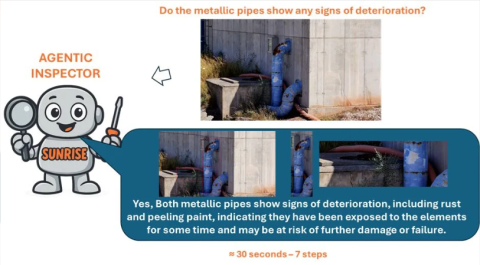
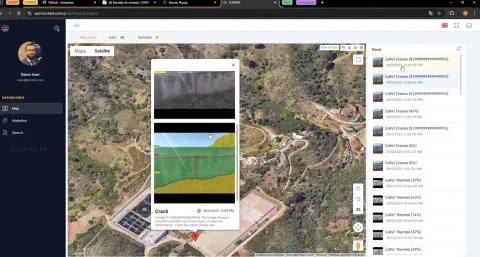
The project SUNRISE, where R&D Spain was the coordinator and leader of the work package "Cyber-Physical Resilience" and the task "Visual infrastructure inspection with UAV", ended successfully after 36 months of work
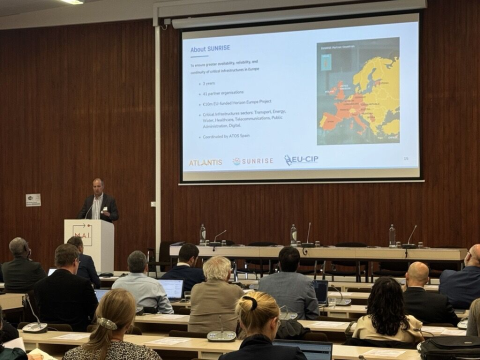
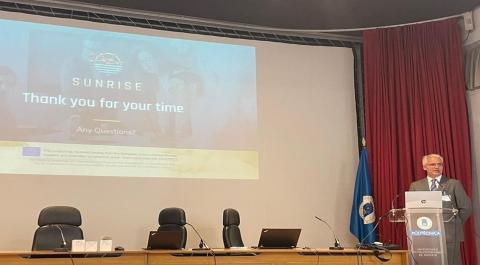
On 29 September, the SUNRISE project joined forces with sibling projects EU-CIP and ATLANTIS to celebrate a final event in Brussels. The event brought together policy makers, practitioners, industry representatives and the research community.
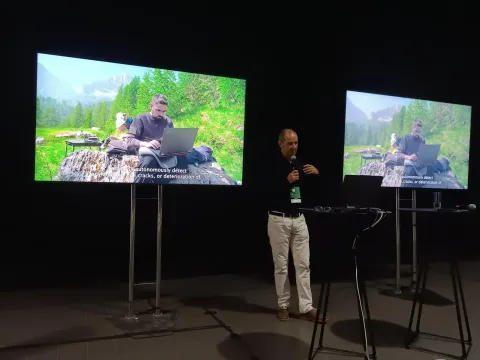
Last 28 March, R&D Spain joined the SUNRISE consortium partners Skyld Security and Defence Ltd and ACOSOL to play a crucial role in the kick off of the final field tests of the SUNRISE Project
The COVID-19 pandemic is an example of a temporary situation when critical infrastructure (CI) operators had to operate with continuously changing conditions. The role of cyber infrastructure during pandemics, for example for the remote work or access to critical systems, has also changed.
"Critical infrastructure operators across Europe must prepare their facilities, equipment, and personnel to operate under more strenuous conditions in a warming climate.
It is widely known that we are living through a historic moment in the field of artificial intelligence (AI), capturing the attention of the entire world with spectacular results across multiple application fields, especially in text and image generation.
Cybersecurity ecosystem in EU is a hot topic, as it relates to the recent establishment of the EU Cybersecurity Competence Centre (ECCC), the Network of National Coordination Centres (NCCs) and the Cybersecurity Community (CC).
With the increased digitalization and adoption of cost-effective off-the-shelf components and cyber connectivity, Critical Infrastructures (CI) operators have benefited in many ways, but the attack surface has also become larger.