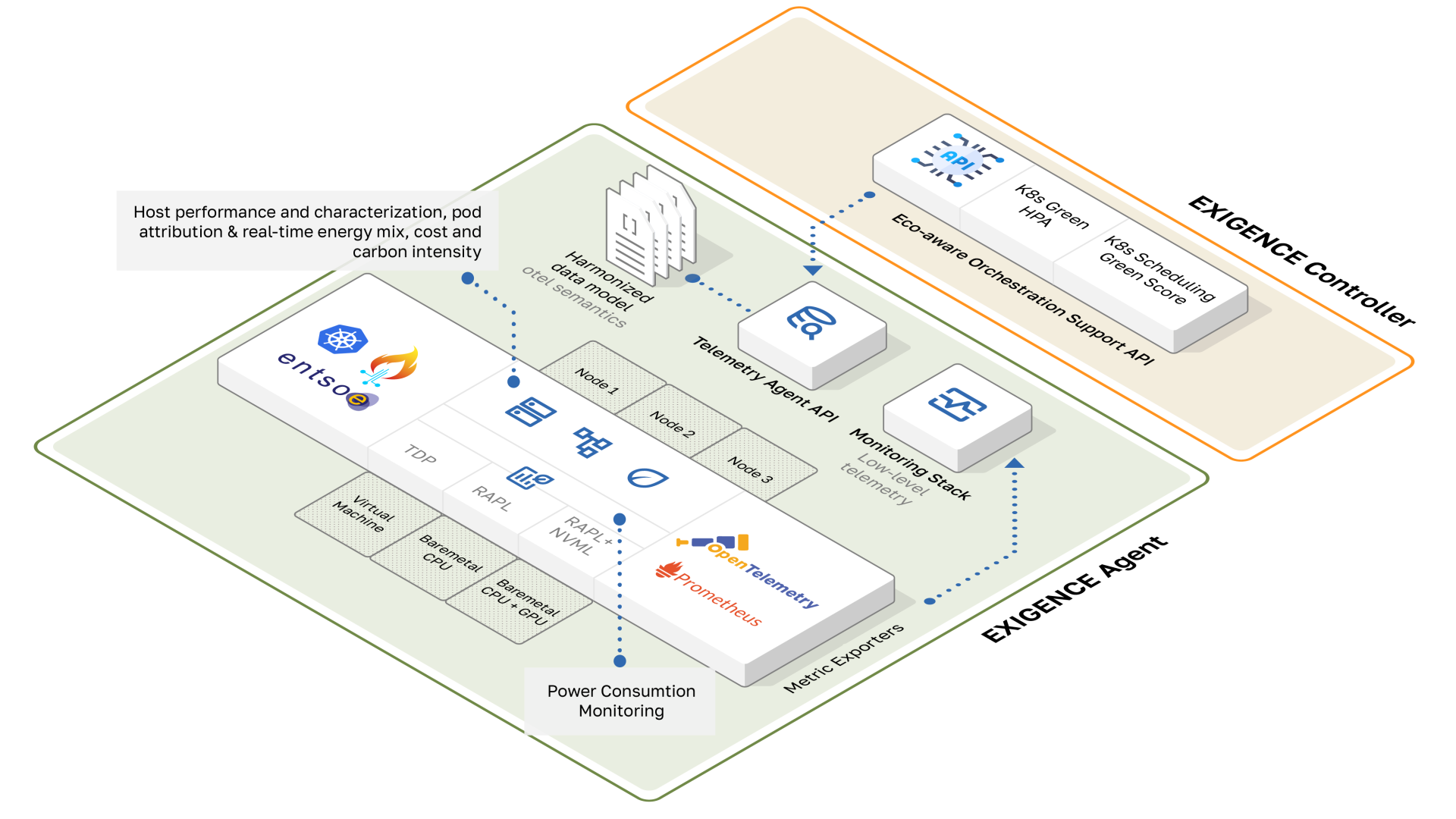
Another core challenge was to provide eco-driven automations without specialized technical knowledge about the underlying infrastructure and the low-level metrics as a way to facilitate the adoption of the eco-aware orchestration framework and its compatibility to different clusters without requiring changes at the application level. To do this, the approach has been to enrich the metric exposure layer with eco-related exporters to later compose a harmonized data model extending OpenTelemetry semantics catalog. The final selection of exporters cover:
- Real-time energy mix, carbon intensity, energy cost for the location of the node pulled from ENTSO-E's public API.
- Hardware characterization per node: PUE, embodied emissions, lifecycle data pulled from the node's datasheets and historical data.
The generated data model additionally enhances all the previous metrics with the calculated SCI score (Software Carbon Intensity) which provides a non-manipulative green score that can be used to compare nodes and workloads across hardware types and industries. The data model covers both, per node metrics, and to each workload found thanks to ALUMET's plugins attribution and correlation plugins, to then drive eco-aware orchestration automations natively integrated in the kubernetes ecosystem:
- A custom green scheduler plugin integrated into the scheduling framework of kubernetes to rank nodes by their SCI scores.
- An implementation of the prometheus HPA to scale workloads based on the harmonized data model. E.g., scale out pods in a deployment when the carbon intensity is low, react to real-time energy prices, enabling a shift from performance-only scaling to sustainability-driven elasticity.
The result is a developer-friendly, eco-aware monitoring and orchestration framework built on top of the monitoring capabilities of ALUMET.
Alumet is a modular, open-source framework designed to measure and monitor metrics such as energy consumption and performance across hardware and software systems.
It provides a flexible, plugin-based pipeline that collects data from multiple sources, processes it, and exports results, enabling users to build efficient and customized measurement tools with minimal overhead.